By Nicola Ryan
Ever wonder what makes a dory different from a punt? Or why sailors delight in a red sky? How long has Purity been making cookies, or what exactly is a ‘jib’ and why does it ‘draw’?
There are stories woven into everyday things in Newfoundland and Labrador – its history, its traditions, and all the details we sometimes notice but don’t fully understand. So, here at Downhome, we’re making space to explore the questions you never knew you had about our province. In the interest of making Newfoundland better known to Newfoundlanders everywhere, let me do the research for you! Let’s start at the beginning with one of the most recognizable symbols of the province of Newfoundland and Labrador – the flag.
Two official flags have represented Newfoundland and Labrador since Confederation with Canada in April, 1949 – the Union Jack, followed by the current provincial flag.
(While many hold the Pink White and Green in reverence, it was never an official flag.)
In May 1931, the National Flag Act officially made the Union Jack our flag. Already the traditional flag of all British colonies, the Union Jack gained even deeper significance here after the First World War, serving as a symbol of respect for the volunteers who fought and died under it overseas.
By the early 1970s however, there were calls to replace the flag with one unique to the province. Remember, this was the Newfoundland Renaissance – a cultural revival where, for the first time, homegrown art began to reflect the lives, language and traditions of everyday Newfoundlanders. Local folks were beginning to understand who they were, celebrating their quirks and taking pride in their unique culture. During this time, ideas for a new provincial flag sparked widespread public debate.
In November 1979, the provincial government appointed a seven-member committee to receive flag proposals from the public and recommend a final design to the House of Assembly. In the coming months, the committee held public hearings and vetoed a number of designs featuring codfish, caribou, pitcher plants, and fisher’s boots. Finally, in 1980, they approached prominent local artist Christopher Pratt and asked him to design a flag of geometric design.
Why geometric? The design draws inspiration from mercantile flags. Traditionally used by ships to identify their nationality or the company that owned them, mercantile flags were a vital way to keep track of coming and goings at sea. They’re how Signal Hill earned its name.
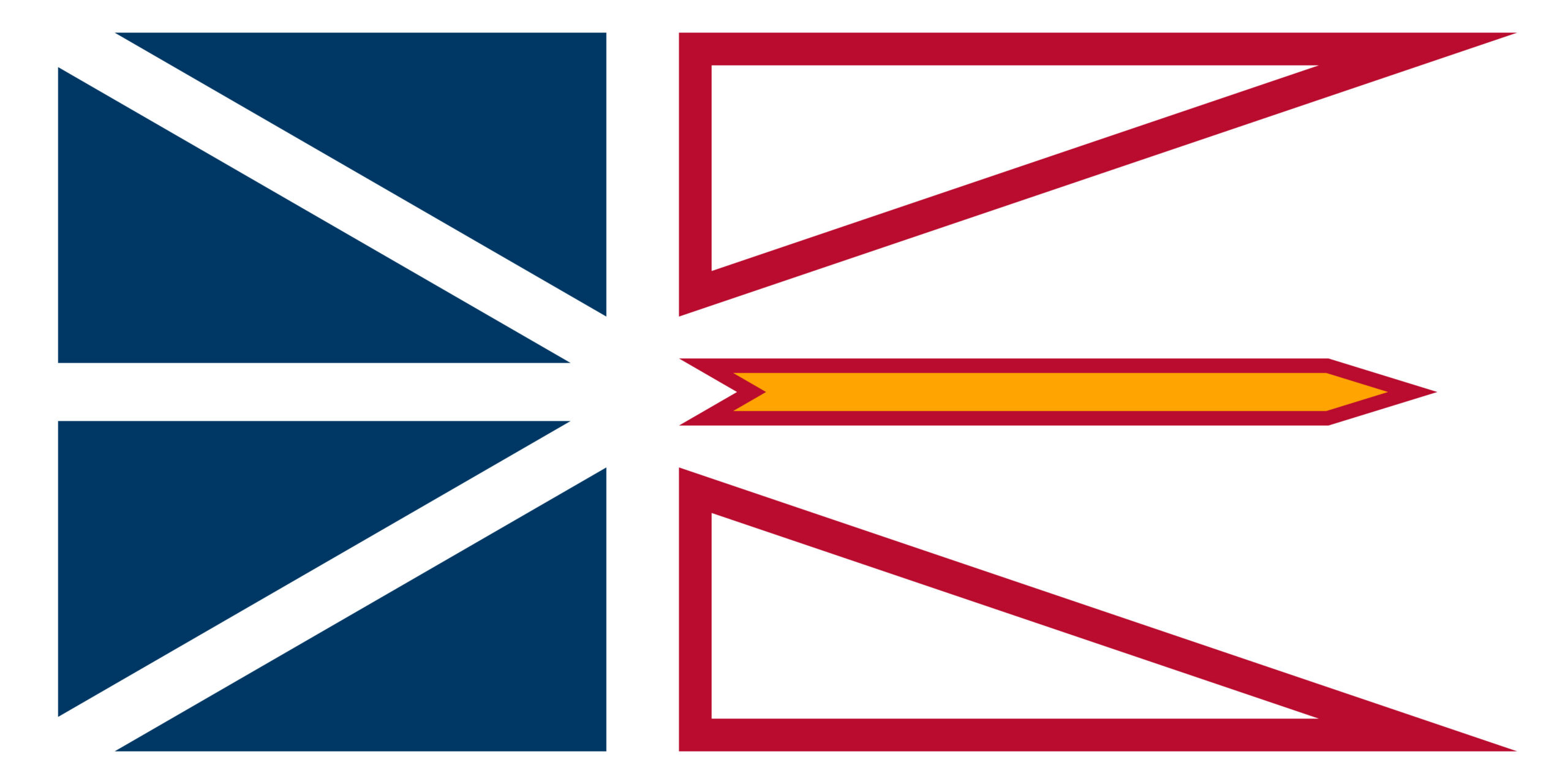
Pratt intentionally designed the new flag to be reminiscent of both a Beothuk pennant, to reflect the province’s earliest known inhabitants, and the Union Jack, to represent its Commonwealth heritage.
It features three main colours set against a white background, each with symbolic meaning. Blue represents the waters of the seas, lakes, and rivers. White stands for the snow and ice that shape our winters. Red represents human effort, and gold signifies confidence and optimism for the future.
The four blue triangles underscore Newfoundland and Labrador’s historical ties to the United Kingdom, and the two red triangles signify the island and mainland portions of the province.
The golden arrow points forward towards a bright future.
When the flag is hung vertically, the arrow becomes a sword, honouring the sacrifice of those in military service. As well, when considered together, the red triangles and golden arrow form a trident, a nod to the province’s deep connection to fishing and maritime resources. Beyond this, the design incorporates additional symbolism, including a subtle Christian Cross and the outline of the maple leaf at its centre.
Pratt’s flag reflects Newfoundland and Labrador’s journey from its earliest beginnings and points confidently toward the future, mirroring the province’s past, present, and aspirations. It was officially adopted under the Provincial Flag Act, receiving Royal Assent on June 6, 1980.
On May 26 of that year, the House of Assembly passed the legislation by a vote of 22 to 10. The flag was first raised on Discovery Day, June 24, 1980, in a ceremony outside the Confederation Building, marking the beginning of a new visual symbol for the province.