By Nicola Ryan
“O, this is the place where the fishermen gather / With oilskins, boots, and Cape Anns battened down. All sizes of figures with squid lines and jiggers / They congregate here on the squid jiggin’ ground.”
With these lines from Squid Jiggin’ Ground, 15-year-old Arthur Scammell immortalized the most recognizable pieces of traditional fishermen’s clothing in Newfoundland. Written in 1928 and later popularized in Gerald S. Doyle’s songbook, the song’s lyrics once required no explanation to Newfoundland audiences. But what are oilskins? But what is a Cape Ann? And how do you batten it down?
Sou’westers
The Cape Ann is a type of sou’wester, a waterproof fisherman’s hat designed to withstand the harsh conditions of the North Atlantic. Its name originated from Cape Ann, Massachusetts, the historic fishing region centred on a place called Gloucester. During the nineteenth century, Gloucester fishermen relied on these distinctive hats for protection against wind, spray, and freezing rain. The design featured oiled canvas, ear flaps, and an elongated rear brim that prevented water from running down the wearer’s neck. Because of its widespread use in the Cape Ann fishery, the style became known as the “Cape Ann sou’wester.”
Ah, but we Newfoundlanders and Labradorians rarely use the same word as everyone else if we can help it. Historian Andrew Horwood notes in Newfoundland Ships and Men, “A sou’wester is a seaman’s head dress that in other parts of North America is known as a Cape Ann. But to a Newfoundlander, it was in the beginning and still is and forever will remain a sou’wester.” The word “sou’wester” itself comes from the weather it was designed to withstand – the prevailing southwesterly winds of the North Atlantic.
To further confuse things, Newfoundlanders also called sou’westers “Lincolns” or “Linkums”. Why? The Joseph H. Rowe & Company, out of Gloucester, manufactured genuine Cape Ann oiled clothing, including different styles of sou’westers. One was enigmatically called the Lincoln sou’wester, though it’s a very different hat from the one usually associated with the famous American president. “Linkum” is just a mispronunciation of that.

Oilskins
Before modern waterproof fabrics existed, sailors and fishermen depended on garments made from oiled cloth to protect against water at sea. As early as the eighteenth century, mariners waterproofed sailcloth and clothing with oils, animal fats, and tar. Knows they weren’t greasy.
New Zealand sailor Edward Le Roy is often credited with standardizing modern oilskins in 1898 by applying layers of linseed oil and wax to canvas. This process also gave traditional oilskins their distinctive yellow colour. Linseed oil, derived from flax seeds, naturally produces a yellowish tint when applied to fabric. Although manufacturers eventually shifted to paraffin-based treatments that were more durable and less prone to cracking, the bright yellow remained an enduring visual marker of fishermen’s foul-weather gear.
In “Outport Memories” in the Book of Newfoundland, Scammell recalls the excitement of receiving his first suit of store-bought oil clothes as a young fisherman on Change Islands.
“What a thrill it was when I donned my first suit of store oil-clothes and my first pair of long rubber boots!” he writes. “Now indeed I had joined the free masonry of the sea; I was apprenticed into the fellowship of the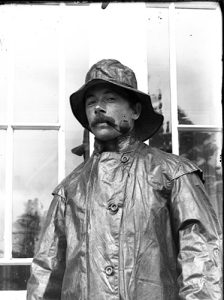 craft. Soon the oiled calico would become chafed and worn…but that first yellow robing, together with the black cape ann, is a highlight in my memory.”
Getting Rigged Out
In the nineteenth century, most Newfoundland fishermen obtained their oilskins and supplies through the truck system, a credit-based arrangement where merchants advanced gear against the season’s catch of cod or seals. St. John’s import firms on Water Street, such as Bowring Brothers and Ayre & Sons, dominated this trade, bringing in textiles and ready-made oiled garments from New England and Britain. Outport merchants like James Ryan Ltd. in Bonavista, or John Munn & Co. in Harbour Grace, then redistributed these goods to fishing communities. Many fishermen also made or repaired their own gear using canvas or worn sailcloth when store-bought options were scarce or expensive.
Battening Down
So, finally, how do you batten down a Cape Ann? To “batten down,” most commonly heard in the phrase “batten down the hatches,” is a maritime term meaning to prepare for rough weather or difficult conditions. If a big storm is coming, waves that crash aboard the ship could send water straight through the hatches. Battening down the hatches meant securing tarpaulins over the gaps, blocking the spaces where water could flow in. When used as an expression in everyday life, it’s simply to prepare for something rough coming your way. So, to batten down your cape ann means to make sure that it’s screwed down on your head and tied tight around your chin to prevent it from getting lost in the drink.
Beyond the Brim
Nowadays, modern waterproof fabrics have replaced oiled canvas, and you can pop down to your local outfitters for your gear. But the language of the fishery remains deeply embedded in Newfoundland culture, and the sou’wester is still an enduring symbol of our fishing heritage. There’s a reason they plunk one on the tourists’ heads during a Screech-In. It’s a reminder of a world of rough seas, hard work and a life shaped by wind, water, and the North Atlantic itself.