by Todd Hollett
For us humans, wooing our partners generally comes with little personal risk, but for some other species, the stakes are far greater. Some males perform showy displays that attract the attention of their intended partner, and also of predators. Fights with rivals may lead to injury or death, and in some instances, males face the threat of a cannibalistic date. Many of these courtship behaviours may seem strange to us, but they are worth every bit of risk and work just fine for species that practice them. Here are a few particularly unusual and extreme rituals:
Three Spined Stickleback
Male sticklebacks become very territorial during the breeding season. They start the season of love by building a tunnel-like nest using small pieces of aquatic plants, usually algae, becoming increasingly aggressive towards other males and fiercely defending their territory, chasing off rivals. To prove to females that he’s a worthy companion, his belly turns bright red, and once he has their attention, he performs an elaborate zigzag dance. If she likes what he has to offer, she will enter the nesting tunnel. The male may nudge her under the chin with his spines to stimulate her to lay 40 to 300 eggs, which he will fertilize. He then chases her away and starts trying to impress other females, until the nest is full. After he’s satisfied with his egg collection, he takes up guard duty and fans them with oxygen for about two weeks. Once hatched, he protects the fry until they are capable of surviving on their own.
Moose and Caribou
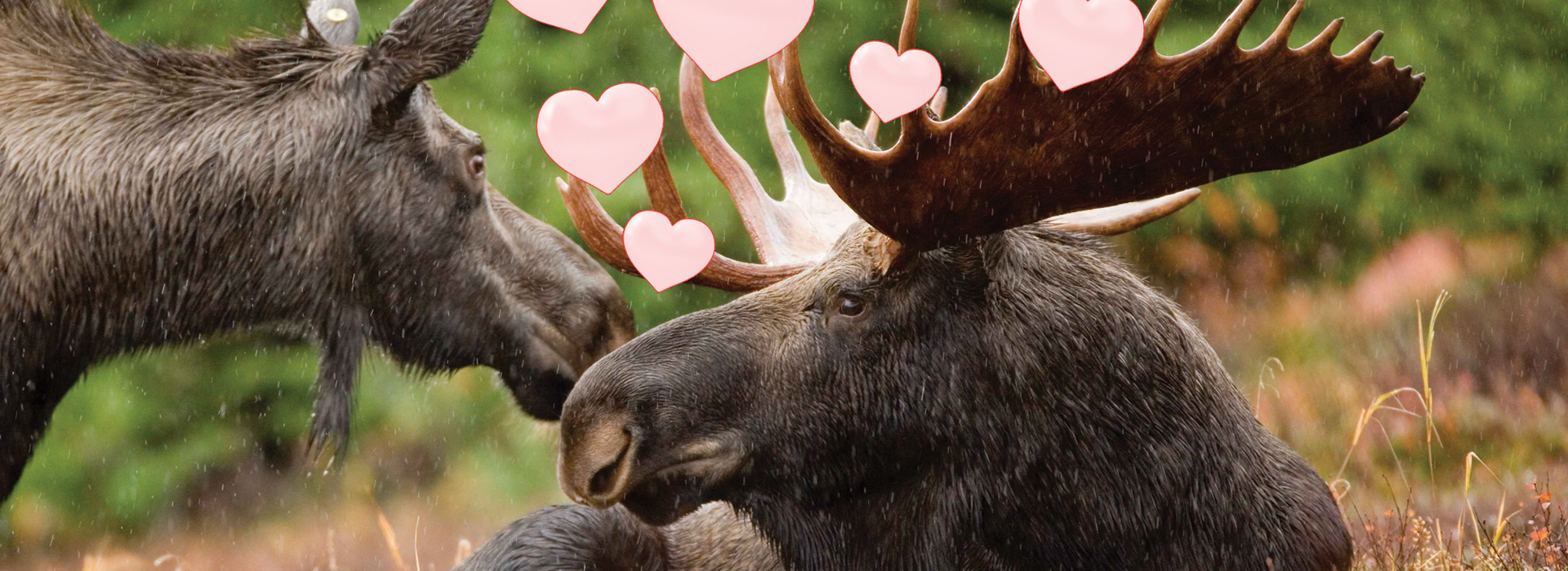
The mating season, or rut, of moose and caribou occurs in September and October, during which the mature bulls go on a hunger strike for about two weeks and concentrate all their energy on finding receptive cows. This behaviour is believed to be caused by neurophysiological changes of the olfaction system to detect pheromones emitted by the females. During mating season, both sexes call to each other, with males producing heavy grunts while females wail. Bulls in rut become aggressive and will fight for cows. Generally, bulls will start a contest by sizing each other up, displaying their antlers, and if one bull appears more dominant, the submissive bull usually retreats. If the bulls match up evenly, or one has a particularly high testosterone level, fights will occur. They use their antlers in sparring contests that may escalate. Bulls have been known to die from injuries resulting from these fights.
Ruffed Grouse
Ruffed grouse are unique among grouse species in their courtship display, relying entirely on non- vocal, acoustic display, known as drumming. Drumming is an intricate process that the male uses to proclaim his territory and attract feathery females. The male grouse will situate himself on a log, stump, rock or dirt mound, puff himself up to double his normal size, proudly raise his crest and spread his tail, beating his wings in rapid fire, creating a low-frequency sound that starts slow and speeds up, making a thumping sound. The drumming can be heard for up to 400 m away, even in thick woods.
North American Porcupine
Male porcupines go to great lengths to secure the affections of the female, especially as she’s only in estrus for 8 to 12 hours. Mating occurs in the fall and is an elaborate process involving loud vocalizations that include grunts, hums, screams and whines. When the female is about to ovulate, she will emit a fragrant mucus mixed with urine that males find irresistible. When a male finds her, he will chase away other males in the area and stimulate her to ovulate by drenching her with an explosive jet of urine that has been compared to a high-speed projectile by experts. If the female is impressed, mating will happen carefully. To avoid injuring either herself or her beau, she will curl her tail over her back to cover the quills. If she’s not receptive, she will shake off the urine and walk away, leaving the male forlorn.
Anglerfish
Anglerfish are true creeps of the deep when it comes to mating, bringing a whole new meaning to clingy boyfriend. These deep-sea fish are sexually dimorphic, with the female usually being huge compared to the male. To locate a bride in the deep-sea darkness, males use a highly developed sense of smell to track a species-specific hormone released by the female. Once the female is located, the male will sometimes use her bioluminescent lure to confirm that the lady is of his own species. Once he’s satisfied that he has found his better half, he literally latches on by sinking his teeth into her flesh, losing all independence. There he’ll live permanently as a parasite, fusing with her and becoming completely absorbed by her body, until all that remains are a pair of gonads that she retains until she’s ready to reproduce.