By Mac Moss
There it was again. A wispy, indistinct form flitting through the trees above him, just at the edge of his vision. He stopped, and without turning his head, backed up several steps and quickly turned his head in the direction of the apparition. But it was gone. He ran forward for five or six yards, keeping his eyes on the trees where the apparition had disappeared, but he saw nothing.
For three days in a row, he sensed that he was not alone on his walk to the beach. After finishing his farm chores, he always ran toward the road that allowed him to join his friends at the brook swimming hole. There, on each of the last three days, he had seen the wispy form keeping pace with him, ghosting through the trees just uphill from his path on the old cart road. The apparition always disappeared when the boy stopped to change into his swimming trunks and poke his clothes into the hole in the clay bank. He knew his friends were at the swimming hole because their clothes were placed into similar holes nearby, and he could hear their excited shouting.
Initially, he felt fear of the apparition and considered returning to his home on the farm, but he knew his mother and Grandfather would quickly find more chores for him, so he kept going toward the beach. The freedom of the swimming hole outweighed the fear of the ghost.
He didn’t mention what he saw or thought he saw to his friends. They would not believe him, or would think he had gotten too much sun while doing his chores. Still, it bothered him; at thirteen years old he should be past the age of believing in ghosts or fairies.
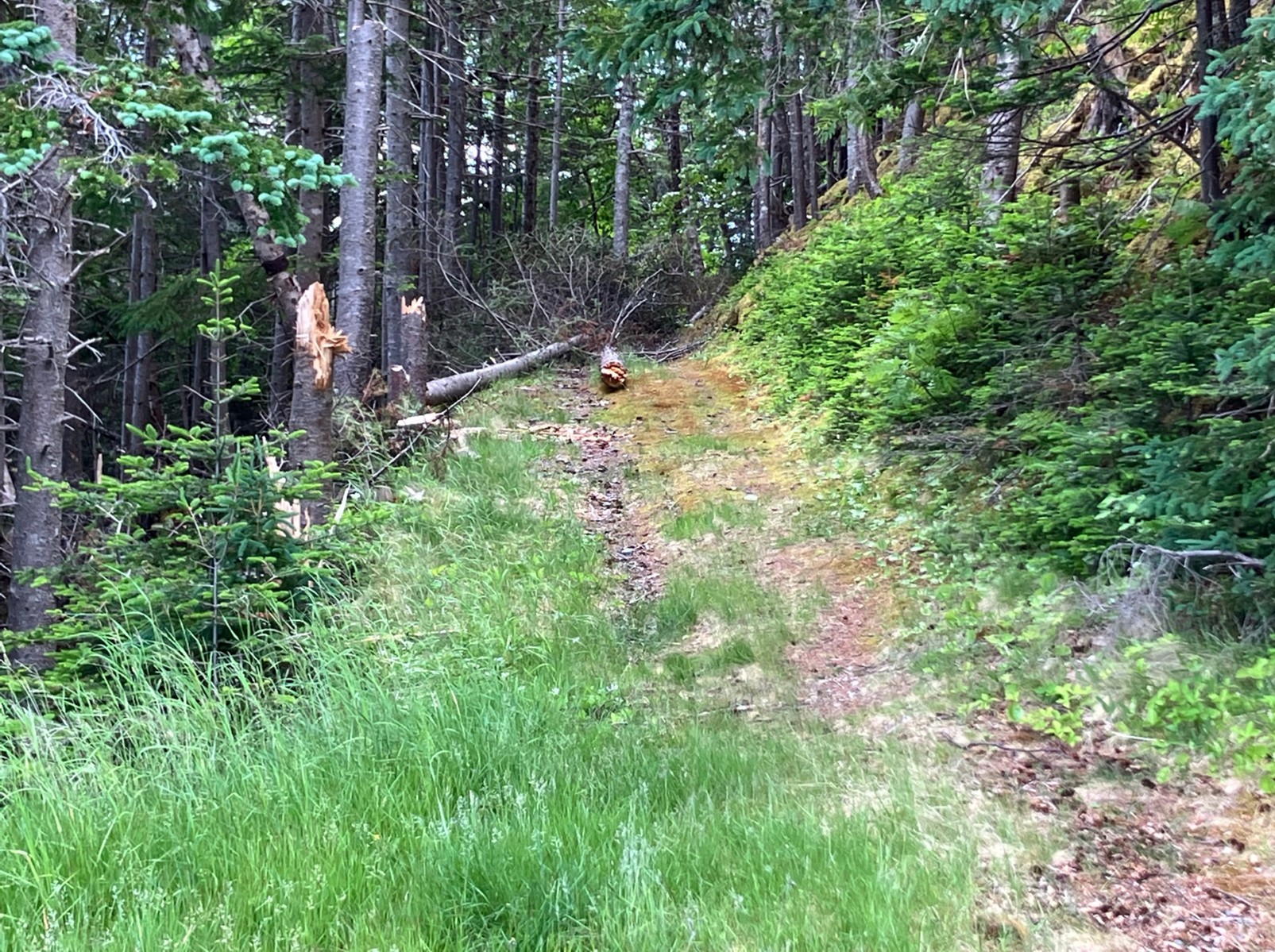
The old Cart Road begins with a stand of tall birch trees close to the North side of Uncle Joe’s property. Less than 20 metres along the road, the sun-dappled path is overshadowed by ancient fir and spruce trees, which block all but the most persistent rays of sunlight. It was never gloomy, though, because the ancient trees had created their understory spacing and even allowed the occasional birch to intrude, opening the overstory to more colour and light. Every day, in every weather or season, a stroll up or down that old road was usually a delightful experience.
One hundred years prior, the road began as a trail leading from the Northwest Beach to the farmland 90 metres above on the glacial plateau. As the first settlers of Salvage Bay (now Eastport) turned their hands from fishing to farming, they could not abandon the sea entirely. It still provided their primary source of protein and was their only route for transportation to nearby communities and the world further over the horizon. The beach and nearby brook provided spawning grounds for caplin, trout, eel and the occasional salmon. The caplin and kelp avail- able for farm fertilizer from the beach prompted the settlers to widen the path to accommodate carts pulled by oxen and horses.
The widening had to be done care- fully and strategically because of the steep slopes of the Northwest Brook Valley. Our ancestors understood the havoc that would result from unchecked erosion and carefully reinforced the roadway with large logs dragged down from the heavily forested plateau. An unwritten agreement among the families was that no trees could be cut down above or below the road. Blowdowns were fair game if young trees were planted nearby, but no living tree could be harvested.
The boy considered speaking to his mother about the ghost but decided against it. He had often heard her comment about fairies, especially when he or one of his siblings put on an article of clothing inside out. “Be careful!” She’d often say, “The fairies will get you!”
He never knew when she was serious, and she discouraged discussion, but he noted that, when she went
into the garden or berry picking, she would always carry a short length of red wool with her and double check her clothing, even making sure that garments removed because of the heat were never left inside out.
The following weekend, after seeing the apparition, when his father was off work for two days, he, along with his father and grandfather, walked to the beach to put out the small speedboat to catch a few codfish. Grandfather had gone ahead of them to open the storehouse and retrieve the outboard motor and gas tank. The boy noticed that his father was touching certain trees as he walked down the road. These trees had all been knotted by Moss men over several generations.
The boy knew every knotted tree and the name of the person who tied the knot. Starting at the top of the trail was a tree knotted by Grandfather William around 1895. That fir tree, though stunted by the knot, was over 15 metres high and 35 or more centimetres in the butt. His brother had knotted the soft growing tip of a fir tree the previous summer. The boy had watched him do it slowly and carefully so as not to break the tree.
Surprised that his father was actively seeking out the trees and silently paying homage to his family, the boy gathered up his nerve and said, “Dad, you have walked this trail for your whole lifetime. I have seen you touch these trees before, but did you ever see anything strange in the woods here?”
His father slowly came to a halt and looked at the boy quizzically. “What have you seen, my son? Have you seen a fairy?”
“I don’t know what I’ve seen,” said the boy, now emboldened by his father’s response, “But for the past several trips to the beach, I’m sure that something up there in the woods has been following me.”
His father was quiet for a moment, then asked, “What shape has this ‘something’ taken?”
“It’s hard to describe a shape,” said the lad, encouraged by his father’s openness, “It’s pretty wispy, but in my mind, it appears to be a young boy.”
His father was again quiet for a moment before saying, “You’ve probably seen Uncle Eugene.”
“I don’t have an Uncle Eugene,” said the boy.
“You do, or you did,” his father said. “Uncle Eugene was my older brother, two years older than me. Like all the Moss boys, he loved to go swimming in the brook. When he was thirteen years old, he stepped on a rusty nail, developed blood poisoning and died. When I was thirteen, I saw what you saw this summer. I didn’t believe my eyes at first and was scared out of my wits. After a while, I learned that the ghost meant no harm to me, and I concluded that it was Uncle Eugene going to the beach with me. You will get used to
it. No sense telling anyone else about it. They probably can’t see it and will think you have gone off your head.”
The boy and his father silently proceeded down the cart road, each lost in thought. When they came to the place that the children used as a change area, his father stopped and pointed up the slope to a misty depression around a tree root. “That’s where I think he resides,” said his father.
As if on cue, a wisp of mist arose from the depression and quickly dissipated among the birch and fir trees.
The boy felt the hair rising on his neck. He looked at his father to see his reaction and was surprised to see he was silently weeping, but smiling. A strange sense of calm then came over the boy, and he stepped closer to his father.
His father put his arm around the boy’s shoulder and gave him a gentle hug; “You probably won’t see him after you get older,” his father said quietly. “I didn’t see him after I turned 15, but every time I walk this road, I always stop at this place on the cart road and say a silent prayer for my dear brother and reflect on the life cut short by a rusty nail.”