Liberator. A gift from above
Hello
My name is Dave Paddon. I live in St.John's NL but I'm originally from North West River, Labrador. Below you will find a short article about a plane crash that took the lives of 9 young men near Goose Bay, Labrador in 1945. Also you will discover the amazing gift that these men bequeathed to the population of Labrador. The story is partly based on an oral account passed down to me and partly on a lot of research in the USAF accident records as well as the records of the base hospital in Goose Bay. I am grateful to Darrell Hillier for his efforts in this research.
I think you'll agree it's an amazing story and this has been made all the more so by my recent contact with family members of the 9 young men. They had no idea.
I hope you will publish the story as I think it is historically significant.
Thanks
Dave Paddon 709 690 7013
Liberator: A gift from above
In the spring of 1945 my father, Dr.Tony Paddon was just back from his war service in the Royal Canadian Naval Volunteer Reserve. He had spent the entire time at sea as a Surgeon Lieutenant-Commander (ship’s doctor) and had served on North Atlantic convoy escorts as well as on minesweepers during the Normandy invasion. After being torpedoed in the English Channel in March 1945 his ship had been written off and hostilities had ceased while he was waiting to join another.
On returning to his home in North West River, Labrador he took over the running of the small Grenfell Mission hospital there, thus relieving his Mother, nurse Mina Paddon, who had spent the last five years doing the job in very difficult circumstances. Her husband, Dr. Harry Paddon had died in 1939 of a simple bacterial infection. Antibiotics could have saved his life but they just weren’t available at the time.
For dad it was out of the fire and into the frying pan you might say. Nobody was shooting at him but the problems he faced in the fields of health and education in Labrador were monumental and he devoted the rest of his working career to overcoming them. No doubt he was mulling over these issues while walking home from the hospital in the summer of 1945 when a local lad came running up to him with a small object clutched in one hand. “What’s this doctor”? My father then got what was probably the biggest surprise of his life. (If you exclude being torpedoed in the middle of the night a few months previous!)
I now need to take you back to January 1945.
The war was winding down but the great airlift of men and aircraft from North America to Europe was at its height. Many of these aircraft transited through Goose Bay (about 25 miles west of North West River on the same body of water). Due to the requirements of war the level of pilot experience was very low and the accident rate quite high. Many aircraft were lost and many of those came to grief trying to arrive or depart Goose Bay. (During my own early flying career I was a Twin Otter co-pilot based in Goose Bay and I often flew with Roy Cooper. He had been a Mosquito night fighter pilot during the war and would often point out wrecks to me as we flew out to the coast of Labrador).
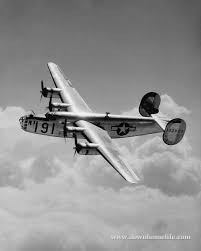
Sometime around midnight on January 13th a USAF B24 Liberator bomber went down shortly after take off from Goose. There was one survivor from the 9 man crew but he died about a week later despite heroic efforts to save him. (These efforts included flying brain surgeons in from the U.S.) I recently obtained the accident report and it was speculated that one engine may have produced a long trail of flame when brought back to climb power shortly after take off. This was not an unusual occurrence with a new engine and the flame would quickly extinguish. All good if you were used to it. The Captain, Roger J Mellion, was 21 years old and had 436 hours total time. It’s not hard to imagine him being distracted by what must have seemed like a dangerous fire and subsequently losing his instrument scan. The aircraft would have been only a few hundred feet up and there would have been little time to recover from a spiral dive.
Now come back with me to the summer of 1945 and the sight of a dumbfounded doctor staring down at a small shiny object clutched in the hand of a young boy.
“Where did you get THAT!”
The youngster said it had been on the beach and that more were coming in on the tide. My father ran the short distance to North West River’s beautiful sandy beach and was further amazed to see dozens of the little things lying about above the high water mark. He told the boy to get all his friends and pick up as many as they could and that he would give them 2 cents for each. (Not bad money for a kid in Labrador in 1945). Dad soon found himself surrounded by a gaggle of excited youngsters who were grabbing all they could. He was doing the same and at one point he stood up, stared wistfully at one of the little objects and thought “If I’d had you a few years ago I could have saved my own father’s life”.
He was holding a vial of penicillin.
It’s hard to overstate how valuable a find this was. Penicillin was new in those days and the medical mission my parents and grandparents worked for simply couldn’t get any. The Allied militaries had it but were using it to treat wounded servicemen in Europe and the far east. As was the case with my grandfather, a simple bacterial infection could be fatal back then and unless you were wealthy or connected you were probably out of luck. And it was miraculously effective. My mother was a nurse in central England all through the war and could remember giving it to wounded troops. They would quickly recover from horribly infected wounds.
The little vials were washing up on shorelines and islands all around the head of Lake Melville and dad instituted a search which resulted in the collection of some 300-400 of them. (There was a prize for whoever could bring in the most and this was won by Sandy Ritch, who I remember very well). It was put to use immediately and one of the first to benefit was a little girl named Stephanie Peacock. Stephanie lived in Nain on the north coast of Labrador and had contracted pneumonia after falling into the town’s freezing harbour. She was close to death when dad arrived on a dogteam medical patrol. He wasn’t even sure how much of the precious drug to give here but took his best guess. Within a few hours Stephanie was sitting up looking for something to eat and I had the great pleasure of getting her side of the story during a visit to Gander, Newfoundland where she is a retired school teacher. I also talked to 93 year old Mrs. Jean Crane who was one of the youngsters who helped pick up the vials in 1945. What an amazing experience to talk to these two ladies!
My father used every vial of the penicillin that washed ashore that day, even into the 1950s when antibiotics became more readily available. He just couldn’t bring himself to throw it away and I find it interesting to speculate about how many of my fellow Labradorians are around today thanks to this event.
To conclude, I will say to the reader that every January 13th I take some time to think of Captain Roger J Mellion and the 8 other young men who lost their lives in the crash of B24 Liberator S/N 44-49538 “The Murmuring Mummy” on that day in 1945. It can't be confirmed absolutely but circumstantial evidence indicates that the penicillin had been part of a freight consignment on the aircraft. It had remained aboard the wreck and gone to the bottom of Lake Melville when the ice broke up in the spring. A few months later it drifted ashore. Mellion and his crew never made it to Europe to take part in the fight against totalitarianism but they made a huge contribution to the lives of Labradorians through their sacrifice.
Some friends and I recently put together a podcast about this event which you can hear using this link. https://youtu.be/OMoNU9dMRo8?si=gqXfHkrDUNhYhfZO
I am in touch with family members of 4 of the crew and hope to increase this number.
Here are the names. They were all in their 20s.
2d Lt Roger J. Mellion
F/O Albert A. Pfeifer
F/O Frank G. Hedlund
Cpl Jack Kohnfelder
Cpl John J. Corrigan
Cpl Waldo E. Robinson Jr
Cpl Wayne W. Robinett
Cpl Joseph G. Wistock
Cpl Robert A. Mallon
Downhome no longer accepts submissions from users who are not logged in. Past submissions without a corresponding account will be attributed to Downhome by default.
If you wish to connect a submission to your new Downhome account, please create an account and log in.
Once you are logged in, click on the "Claim Submission" button and your information will be sent to Downhome to review and update the submission information.
Leave a Comment
MORE FROM DOWNHOME LIFE
Recipes
Enjoy Downhome's everyday recipes, including trendy and traditional dishes, seafood, berry desserts and more!
Puzzles
Find the answers to the latest Downhome puzzles, look up past answers and print colouring pages!
Contests
Tell us where you found Corky, submit your Say What captions, enter our Calendar Contest and more!