By Nicola Ryan
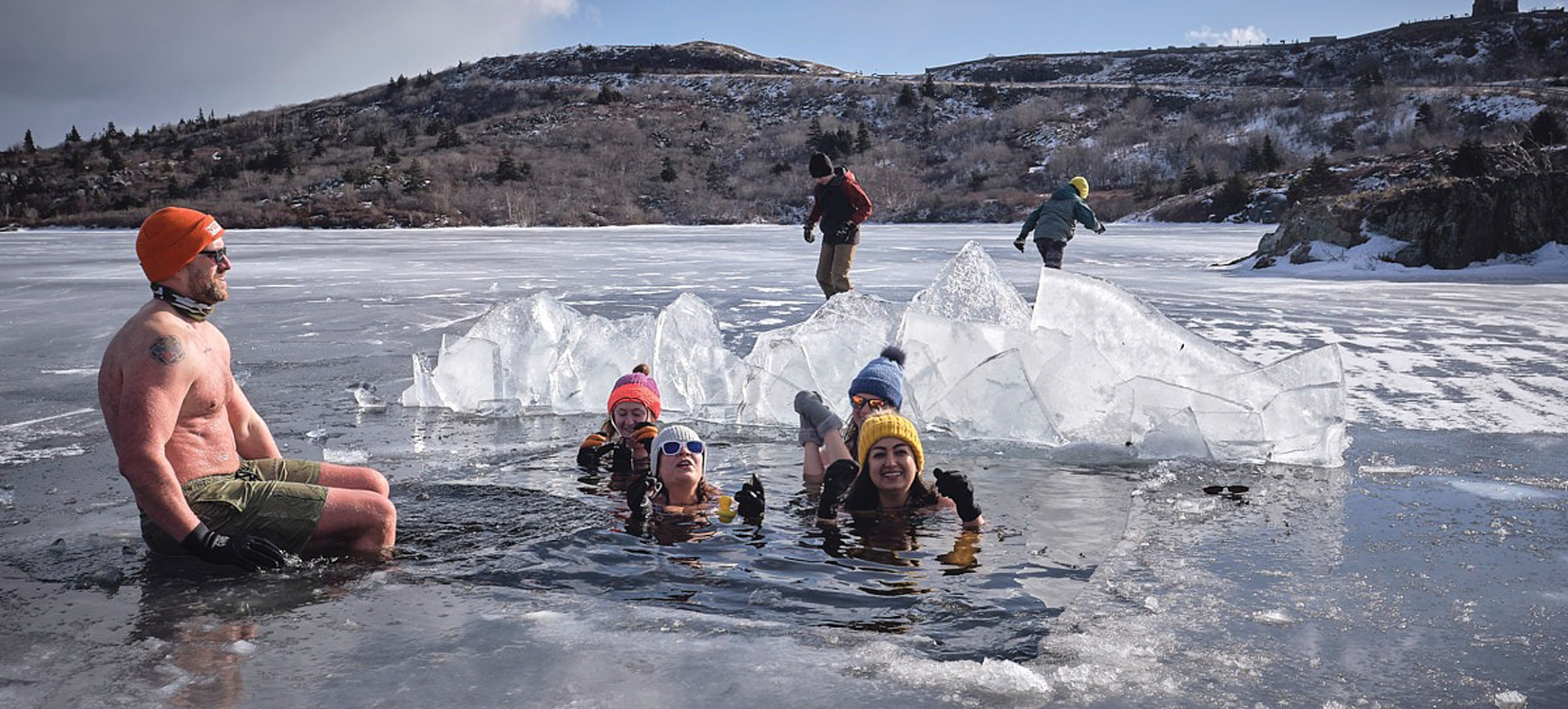
It’s blowing a gale on Signal Hill. Clouds scuttle across the sunny November sky. It’s windy enough to wrench the door off the car, to blow the hat off your head. It churns whitecaps in George’s Pond. Folks pass by in winter coats and hats, and I’m in a bathing suit. I’m here with Brent Beshara, his bathrobe billowing, to learn about cold water exposure. And that means getting in.
Brent guides people in exploring both the physical and mental benefits of cold exposure. With a big smile and grey curls tucked under a rainbow beanie, he chats with the easy effortlessness of a seasoned public speaker.
“Why would I go so willingly into such cold water?” he asks with a laugh. “Well, a little background. I was in the Canadian military for 24 years and a day. My first six years I was in the infantry, and the next eighteen years were as a special forces Navy bomb disposal diver. I had two tours overseas. I got back from Afghanistan in March of 2004, and I retired in ’07. We moved here to Newfoundland in November of 2009. Keli-Ann’s from town, my bride.
“To deal with the stress of dealing with high explosives on a daily basis and being responsible for people’s lives, I was on medications,” he continues. “Then when I got out, through lifestyle choices of yoga, eating better, walking more, learning to meditate and breath work, I got off this medication – and support from my family, of course. But then in September 2015, my doctor said, ‘Hey Brent, you’re pre-diabetic,’ and I was shocked. I think I’m fit, I work on my fitness, it’s my passion, so to hear that I was really shocked.”
In October of 2015, Brent heard about a man from the Netherlands, Wim Hof, the Ice Man. Wim’s method of mindset, breathwork, and gradual cold exposure safely stresses your body, which can improve circulation, increase energy and boost immunity.
“I went to Toronto the following year and did a one-day workshop with him, and then I was inspired,” Brent says. “And the best way to learn something is teach it, so I went to Amsterdam and Poland to become an instructor in the method. I was a military instructor most of my career, so I love teaching, I love sharing, I love the experience of teaching, it’s fantastic. So I started the NL Winter Crew – I made a Facebook group to get people to come out – and now I’ve taught hundreds of people cold exposure.”
As I dither at the pond’s edge, Brent grabs my hand and strides confidently into the water.
So what is cold exposure? Hormetic stress is a concept from biology: small, controlled doses of stress can actually make you stronger. Think of it like exercise for your cells. A little challenge – like dipping in icy water – triggers repair and adaptation, so you become more resilient over time.
“If we don’t give our body a challenge, if we continuously seek comfort, our body will give us a challenge,” Brent explains. “That’s where we get auto-immune issues like fibromyalgia, lupus, Lyme, Crohn’s, Addison’s, Hashimoto, obesity, diabetes. So what we’re doing is we’re allowing our bodies to adapt, to strengthen our cardiovascular system, our veins, nerves, bones, muscles and fascia.”
Slow, controlled breathing is the key to the experience in the water.
“We do a yoga breath,” Brent explains. “Slow in through the nose, hold it for a moment, and then longer outs. We just take a breath in, get down to our waist in the water and then start the slow breathing. Then it’s only two minutes, right? That’s all you need to initiate the body’s response to hormetic stresses. It’s called shock proteins, and you get them through heat or cold. What we’re doing is allowing the body to adapt to the available conditions. You see farmers, fishermen, they’re outside all year round handling ropes and lines and gear without gloves, right, cause they’ve adapted to the cold. And it’s fantastic because the cold is free, there’s lots of cold in Newfoundland.”
In the pond, the wind whips my hair into my eyes as I follow Brent into the choppy water. Neck-deep now, my nervous system is shrieking. I’m probably breaking Brent’s hand. I set my mind. I take deep breaths through shivers. I try not to think of the warm Downhome office where I usually spend mornings drinking coffee. Brent, who does this every day, looks comfortable, calm and steady. After about a minute, the initial shock eases, and I feel a little better. The sun glints off the ripples in the water. I settle into breathing. I think of bragging rights and health benefits.
There are lots of benefits to cold adaptive training.
“It’s anti-inflammatory, right off the bat,” Brent says, describing how chronic inflammation, the body’s natural response to injury or infection, like swelling, redness, or pain, can contribute to health problems like diabetes, arthritis, heart disease, or autoimmune issues.
“It makes a difference, and I’m living proof of it,” he says. “I was diagnosed with pre-diabetes in 2015. Every year after that, since doing this method, my doctor said my numbers have gotten better and better and better. As Wim says, ‘a cold shower a day keeps the doctor away.’ Especially seasonal flus, I haven’t had a seasonal flu in years.
“My next big point is that it is totally a mental health thing. It creates dopamine and serotonin, and all the feel-good hormones within the body. Van Gogh, he was prescribed two cold baths a day for his depression two hundred years ago. But apparently, he didn’t listen. It also helps with pain deactivation, reducing pain receptors in the body. The health benefits are profound. It’s a biological superpower.”
To Brent, mindset is everything.
“I do it first thing in the morning, and it gives me that mindset of carpe diem/ joie de vivre/ seize the day. It’s like making your bed. It’s one of these little tips, tricks, techniques that set us up for a successful day. And you’re physically doing something to promote health within your body.
And you don’t need to be a freak like me or the crew; you can just do cold showers. Take a two-minute cold shower, rinse off; it tightens the skin, closes the pores, it’s great.”
Back at the pond, our two minutes are up, and we splash back onto the bank. Brent cheers and gives me two thumbs up. My legs are tingling, and I feel so exhilarated that I want to laugh and dance. Brent’s guidance makes the icy water feel inspiring rather than impossible, turning the cold into a challenge worth meeting. Would I do it again? Maybe. But first, let me bask in this chilly victory.