By Cassandra Filice
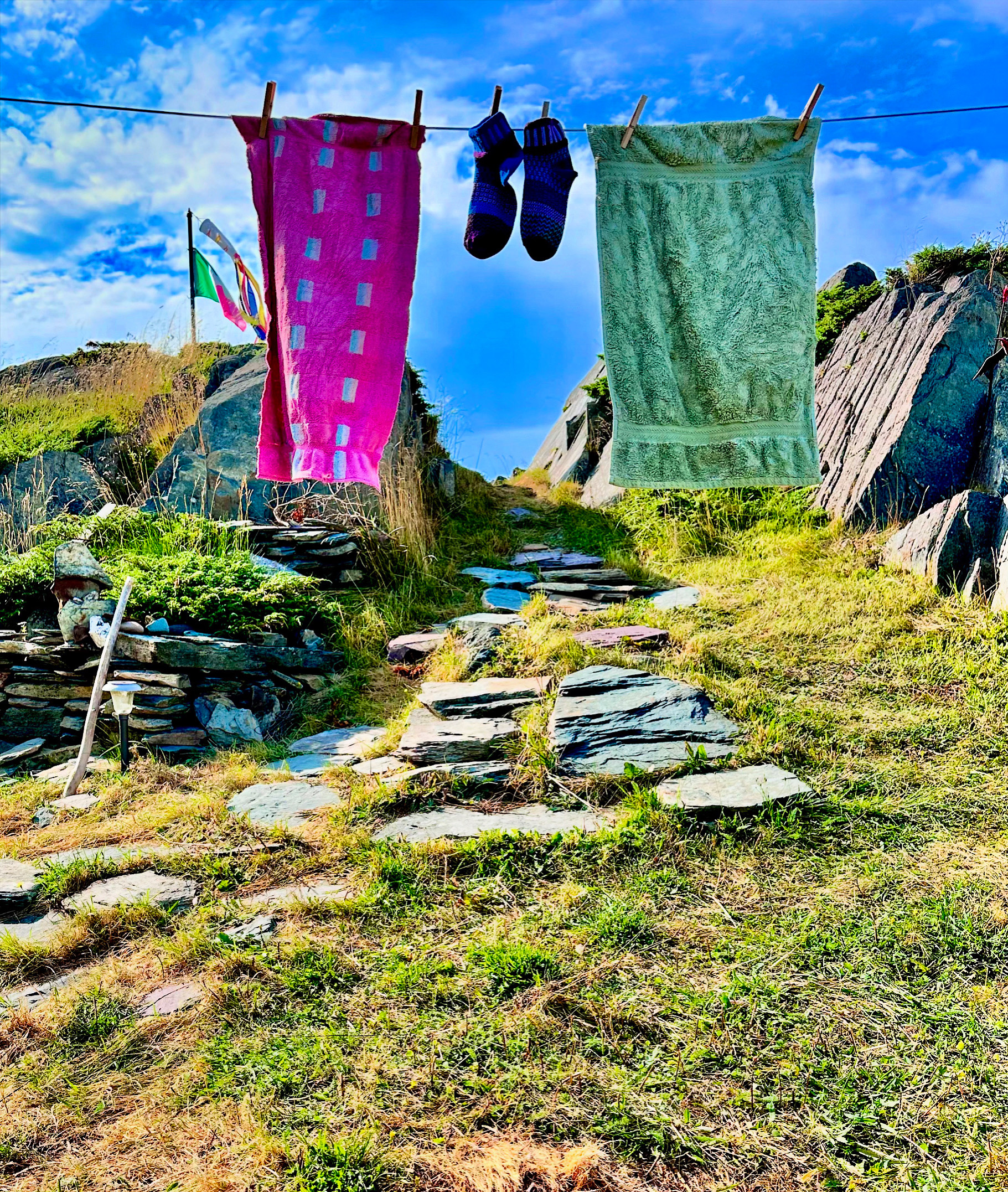
Among our iconic Newfoundland and Labrador commercials, few scenes are as memorable as colourful laundry blowing in the saltwater breeze.
Clotheslines are a quintessential element of our provincial brand. Sure, we love a cute goat crossing a finish line, and the quality of our fiddle music can’t be denied, but clotheslines have been in dozens of print and out-of-home ads, with appearances in several video and television campaigns over the years. You’d be hard pressed to find a year where they weren’t featured in provincial promotion.
Clotheslines are such an intrinsic part of our culture that replication through art can be seen in many of the local shops along Water Street and Duckworth Street. From stained glass and sea glass creations, to driftwood and knitted wool, little clothesline tchotchkes abound.
What is art, if not a story? Our province loves a good story, and every clothesline tells one. In decades past, a glance at the drying laundry during an evening stroll provided a wealth of information: the ages and occupations of the residents, their economic status, and whether the housewife was tidy or slovenly. Just a generation ago, the clothesline was the unofficial telephone line. Neighbours met to exchange gossip, recipes, and remedies, and escape a steamy stove or a crying child.
When you stop to think about it, if a clothesline tells a story, isn’t that also art?
Kimberly Ropson is a well-known Newfoundland artist whose work features in galleries across the province. Many of her signature landscapes feature a clothesline.
“They evoke a sense of nostalgia for me,” Ropson says. “Growing up, my parents didn’t own a dryer; therefore, we only ever knew the freshness of garments from the line, laden with an aromatic Great Harbour Deep breeze.”
Ropson continues, “In relation to my art, I feel there’s something very special about the interplay of sunlight and shadow as each garment sways in the wind. Quilts, in particular, hold a lot of history and personality, often reflecting the quilter’s life. My paintings generally contain these stories as I move through each stroke of the brush.”
Ropson isn’t the only artist who’s drawn to the clothesline.
Margaret Ryall grew up in Placentia as one of eight children. “With so many of us, there was always clothes on the line. Laundry was a daily occurrence as long as the sun was shining. Back then, clothes were washed with a wringer washer; there were two rollers you put the clothes through to squeeze out the excess water. I remember getting my arm stuck in it one day!”
Ryall now takes an aesthetic interest in clotheslines. “For some people,” she says, “hanging laundry is like an art. I enjoy seeing how everything gets pinned together – are clothes hung by colour? Size? Type?”
The idea of the launderer as curator is certainly appealing: designing public space with private items, changing the landscape, blocking views while simultaneously creating new ones; joy and beauty can be pulled together from the quotidian details of our lives and hung like a garland, drawing our eyes upward and bringing a moment of reflection to our day (or possibly angst about our toppling piles of soiled linens awaiting us).
Poetry, another art form, has also long embraced the clothesline. From Ruth Stone’s “Things I Say to Myself While Hanging Laundry” (1996) to my personal favourite, Richard Wilbur’s “Love Calls Us to the Things of This World” (1956), themes explored in these poems include what it means to live life in community, the observations and judgments of open secrets, and how women’s work and worth are brought to light outside the confines of the home. Topics in clothesline poems can highlight the simplicity of a fresh breeze, the tiny movements of a solitary ant, and the pleasure of the mundane.
The clothesline has also infiltrated social media. A quick hashtag search on Instagram reveals over a quarter of a million uses; related hashtags such as “clothespin” and “washline” also trend. Entire accounts are dedicated to laundry hung out dry, which points to another interesting trend as more and more people become eco-conscious (and as hydro bills soar).
Life around the bay frequently meant you had to be thrifty, and being thrifty usually meant extra work. Women and children hung out the laundry because that’s what their mothers and grandmothers had done before them, and because dryers were an unheard-of luxury. But while laundry lines were ubiquitous around the bay, as normal as tea and toast, the dryer was seen as a status symbol in St. John’s.
“My mother grew up in the poorer, working-class neighbourhoods of town,” recounts Beth Power. “When we were able to move to a larger home in a better area, the first thing she wanted was a dryer. To her, not hanging out your bloomers was a sign of moving up in the world.”
“Now,” Power notes, “when my husband and I are able to get to our home around the bay, I can’t wait to hang out the wash. I love the smell, I love that it’s better for the environment; there’s definitely something therapeutic about reeling in the laundry and folding it into a basket outside.”
My memories of the clothesline include running through heavy, damp bedding while playing tag, the fabric wrapping around me as my mom yelled at us from the window. When I was older, I would tie-dye my shirts and dresses, and they would resemble hot air balloons as they filled with the breeze and danced and billowed in the afternoon warmth.
Dare we say that a clothesline can be a genre? How about a medium? What about an adage? “A tidy line is a tidy mind!”
Perhaps, like many parts of life, it’s what we make it. And when the laundry is done for the day? The clothesline’s a handy spot to dry out those cod!