By Nicola Ryan
We recently received a letter from a reader who wrote to respectfully request that we correct our use of the expression “a fine kettle of fish.” According to our correspondent, the proper expression is “a fine quintal of fish” – a reference to the traditional measure of codfish. It’s a reasonable request, but on closer inspection, the two expressions aren’t interchangeable.
“A fine kettle of fish” and “a fine quintal of fish” are two different expressions with two different histories. A quintal was indeed an important measure in the Newfoundland fishery, while a fine kettle of fish is an old English idiom describing a messy, muddled or awkward situation – the sort of mess that makes you wonder how the blazes you got yourself into it.
That said, our reader has stumbled onto an interesting bit of Newfoundland linguistic history. There’s long been a theory that the Newfoundland pronunciation of quintal may have played a role in the development of kettle of fish. It’s an intriguing possibility that sent me skipping off to the Dictionary of Newfoundland English. So, before we throw the kettle overboard, let’s look at where these two expressions actually came from.
Not Your Nan’s Kettle
I think it’s very important to point out right from the beginning that, when we’re saying “kettle” here, it does not mean a teakettle. Do not go putting stewed-up fish in a teakettle. Do not commit such an unforgivable crime against nan’s cup of tea. Don’t do it, no matter what the idioms say.
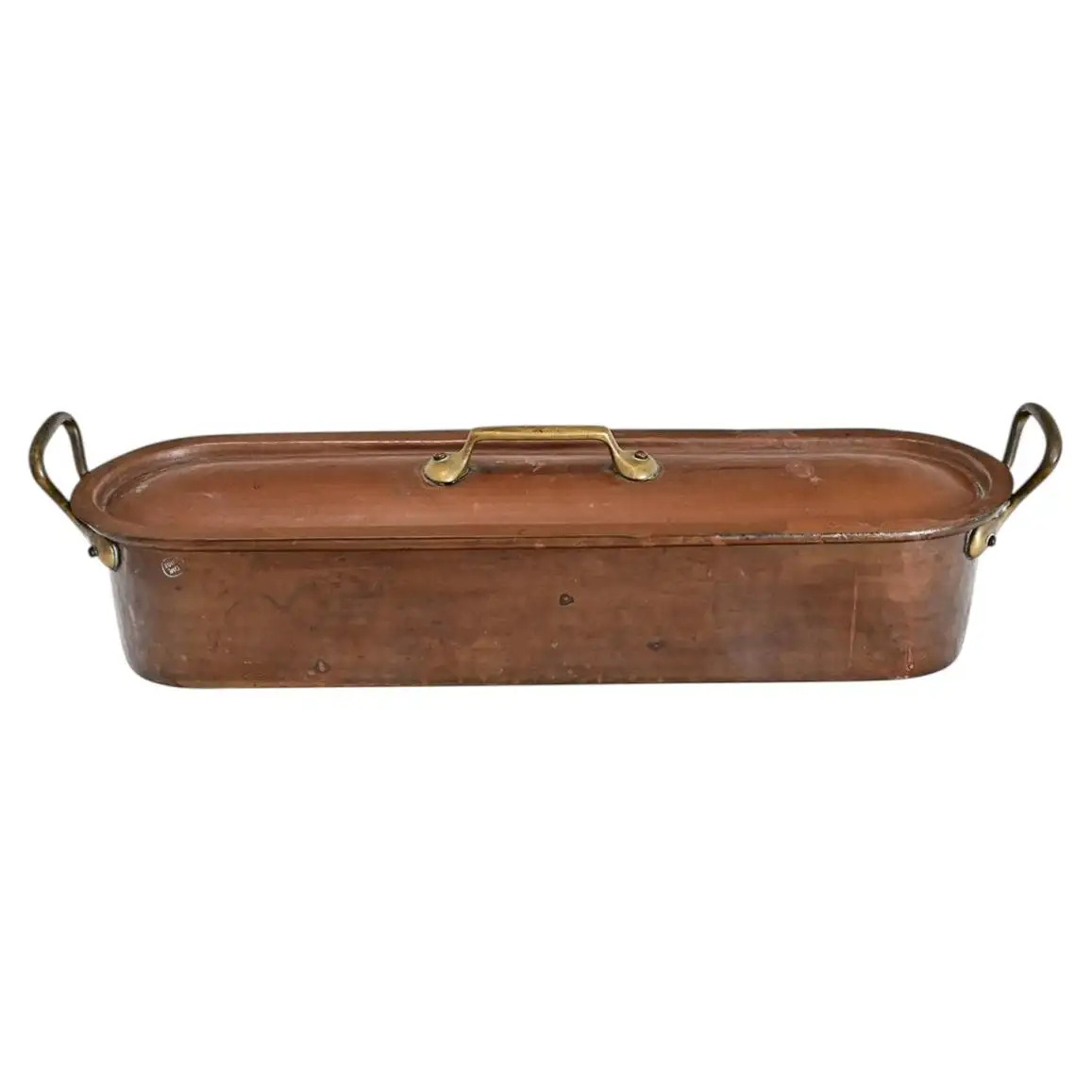
In this context, fish kettles are the saucepans specifically used for poaching fish, which began appearing in England in the 17th century. These specialty pans were long, up to 32”, to accommodate large fish, narrow, and usually oval. They have handles on each end, a lid, and often a rack or tray inside that also had handles so the fish could be lifted out whole. They were made from copper and sometimes lined with tin. The ‘kettle’ word most likely comes from the Latin noun catillus: a deep pan for cooking. In this case, kettle is for cooking fish, and a quintal is for weighing it.
A Boatload of Fish
What’s a quintal? A quintal is a measure of either fresh or dried and cured fish. The earliest English fishermen in NL in the 16th and 17th centuries used quintals to measure their catches. The word likely derives from the Medieval Latin quintale, which originated in the Latin centum, meaning hundred.
 Technically equal to a hundredweight, a quintal is customarily considered to be 112 lbs (about 50kg) of dried, salted codfish. Why such an odd number? Well, fishers and merchants wanted to allow for further moisture loss and spoilage, so by the time it got to the buyers it’d be 100 pounds of good fish. About 120 fair-sized fish make up a quintal, as roughly 238 to 250 lbs of fresh fish are needed to produce one quintal of dried fish.
Any Grand Banks fisherman worth his salt could see a boat approaching and judge roughly how many quintals she had aboard by how far down she rode in the water.
Say What?
Some word historians suggest that “kettle of fish” might actually be a corruption or mishearing of “quintal of fish”.
In the 17th century, Newfoundland’s economy was dominated by a large seasonal cod fishery, operated mainly by fishers from the English West Country, particularly the counties of Dorset and Devonshire, which were major centres of trade. Fishermen from the Channel Islands of Guernsey and Jersey also took part on a regular basis, and traces of their accents and linguistic patterns still echo today. Think of the hardworking men with their brogues blazing. Quintal could have been pronounced cantal or kental or kintall. Sure, in the way all those accents muddled together, it’s lucky we’ve got English in a recognizable form at all.
A Fine Mess
No one knows for sure when “a fine kettle of fish” became a common saying, or exactly how it got its meaning. Etymologists note that the idiom was already recorded in Britain by the 1730s, meaning a messy, muddled or mixed-up situation usually caused by one’s own actions.
It seems to come from 18th-century Scotland, where rich gentlemen living near the River Tweed would invite their neighbours and friends to a fancy picnic. Tents were set up along the riverbanks, fires built, and live salmon were tossed into large kettles of boiling water to cook. They called these gatherings “giving a kettle of fish.”
One theory is that the gatherings could be pretty noisy and chaotic, so someone may have started using the phrase as a joke to describe a messy situation. Either way, somewhere along the way, “a fine kettle of fish” went from being an actual pot of salmon to meaning a confusing or problematic situation.
So, while the quintal was an important part of Newfoundland’s fishing history, the two expressions have separate histories. “A fine kettle of fish” was already an established English idiom before it appeared in Newfoundland speech. Still, it’s easy to see why the two became tangled together. Newfoundland was built around fish, and our language, like our fishery, was shaped by people coming from different shores, bringing their own words and pronunciations with them.
With apologies to our correspondent, a fine quintal of fish is a real thing and a fine kettle of fish is definitely another. And if you’ve managed to land yourself in such a thing, well, that’s a whole other article.