By Pam Pardy
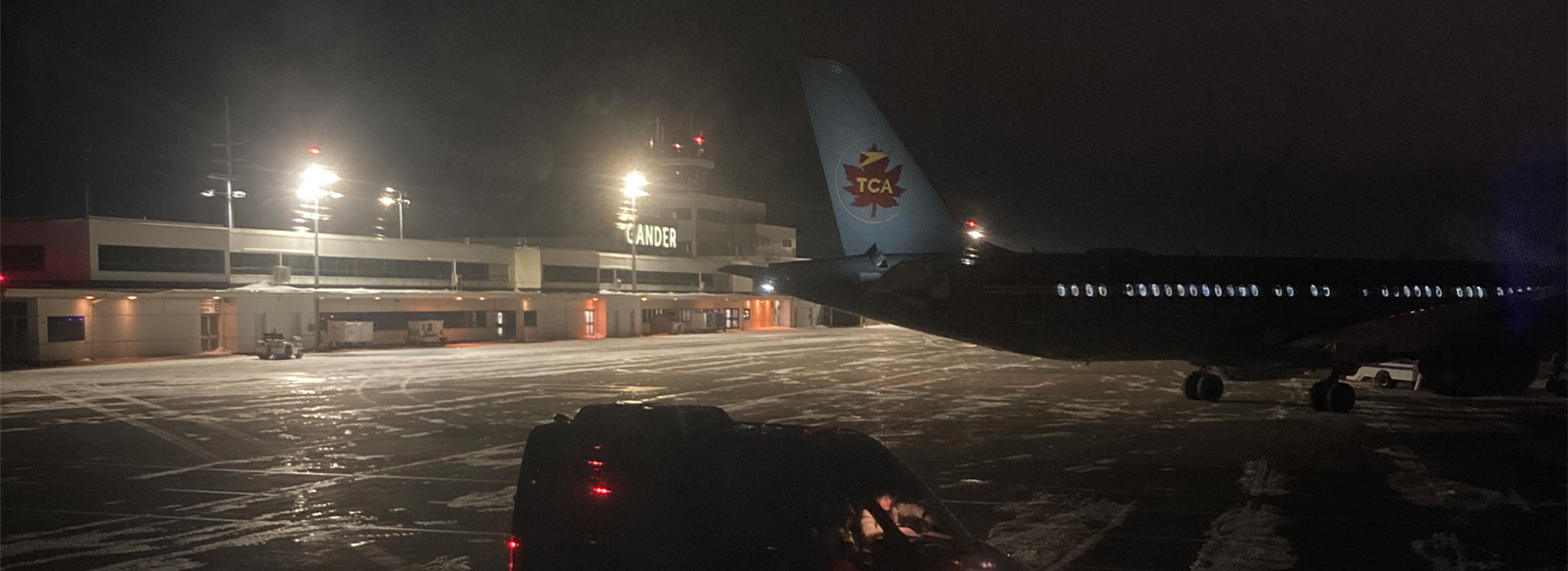
On the night of January 7, two commercial flights bound for St. John’s were forced to divert to Gander when icy runway conditions made landing impossible. For the more than 200 weary passengers onboard, it was an unexpected stop, one that brought frustration, uncertainty, and the familiar fatigue of air travel. What they did not expect to experience was kindness from total strangers. These weary travellers experienced not just courtesy, but the kind of quiet, no-questions-asked generosity that turns a long night into a lifelong memory.
Monet Hoyt was one of those passengers.Travelling home from New Brunswick to St. John’s via Montreal, Hoyt was aboard Air Canada Flight 674 when the plane was redirected to Gander. The original plan, she recalls, shifted repeatedly: first de-icing delays in St. John’s, then talk of returning to Montreal, before the crew reached their maximum flying hours and passengers were finally deplaned in Gander sometime between 7 and 8 p.m.
“There were no Air Canada representatives on-site,” Hoyt explains. “Phone wait times were over an hour and a half. We got our bags after about an hour, and then we were all just… standing there.”
Most passengers received text notifications assigning them hotel rooms. Transportation, however, was another matter.
“There were only two taxis running in Gander that night,” Hoyt says. “The hotels were two to three kilometres away. It was after 10 p.m. Walking wasn’t an option.”
Hoyt phoned her hotel, the Quality Hotel & Suites, to ask if there was a shuttle. The answer was no. But the conversation didn’t end there. That call landed with Jackie Freake, the hotel’s assistant manager. Freake had already been alerted that diverted flights were coming, but something felt off, she shares.
“Normally, passengers arrive in waves. But they were trickling in one by one. That’s when I knew something wasn’t right.”
When Freake learned that there were only two taxis serving hundreds of people, including elderly passengers and a traveller in a wheelchair, she paused.
“I didn’t know what to tell them at first. They were cold, hungry, exhausted. I got off the phone and said to my coworker, ‘Rick, what are we going to do?’”
So Freake did what many Newfoundlanders do instinctively. She opened Gander Connect, a local Facebook group, and made a simple post: “Hundreds of stranded passengers. Two taxis. Help needed.”
“I didn’t ask people to pick anyone up,” she says. “I just shared what was happening.”
The response was immediate.
“Within minutes, people were getting out of their beds,” Freake says. “Some were in lounge clothes. Some were on their way to bed. They just showed up.”
Locals drove to the airport, rolled down their windows, and asked strangers, “You going to the hotel?”
And strangers got in. Hoyt was among them.
“The man who picked us up was actually Jackie’s husband,” she laughs. “He wouldn’t take a cent. None of them would.”
Within an hour, every passenger from both planes had been transported to one of four Gander hotels, not by shuttles or corporate logistics, but by neighbours.
“We were one of the last groups to leave,” Hoyt says. “We’d ordered pizza to the airport and figured others needed rides more than we did, so we didn’t mind waiting.”
She pauses. “I don’t think people realize how big that is. How picking up stranded strangers late at night could mean so much.”
The kindness didn’t end there. The next morning, Freake arrived at work early, knowing departures would begin around 10 a.m. Outside the hotel, she found another problem: the same two taxis, another long line.
“So I posted again,” she says. “Round two.”
Once more, Gander responded. Teachers. Postal workers. Office staff. Retirees. People heading to work stopped at hotels across town, loaded up passengers, and dropped them at the airport.
“It got to the point where I had more volunteers than passengers,” Freake says.
For Hoyt, the experience was surreal.
“It felt like a smaller version of Come From Away,” she says. “And it was comforting to know the heart of the community hasn’t changed.”
She was so moved that she contacted the media the next morning, not to complain, but to make sure the story was told.
“I tried to tip people. They wouldn’t take it. So this was the only way I knew how to give back, by telling people what Gander did.”
Freake, meanwhile, has found herself fielding calls from across the country and beyond: radio stations in Vancouver and Ontario, national television, and even the New York Times.
“People are calling the hotel just to say they’re coming to Gander this summer because of this,” she says. “One man told me he’s using our town as an example in his classroom, to show how small actions matter.”
When asked whether this kind of response is unique to Gander, Freake doesn’t hesitate. “I think it’s Newfoundland. Any small community here would do the same.”
Hoyt agrees. “In a world where it’s easy to forget how good people can be, this reminded me.”
On a cold January night, in a town built around runways and resilience, strangers once again showed what it means to come through: quietly, humbly, and without expecting a thing in return.